Location-Based Intelligence in Smart Logistics: How Anchor Zoning Enables Scalable IoT Asset Tracking
The right information. At the right place. At the right time.
In modern logistics and production environments, context determines efficiency. Materials move continuously, inventories shift dynamically, and operational decisions must be based on reliable, location-aware data. Location-based information connects digital content directly to the physical position of assets — transforming displays into intelligent, process-driven interfaces.
At PDi Digital, this intelligence is powered by the sepioo® Platform and our sepioo® Button Displays, combining hardware, firmware, and cloud-based orchestration into one scalable ecosystem for smart logistics.
Location-Based Information Overview
What Is Location-Based Information?
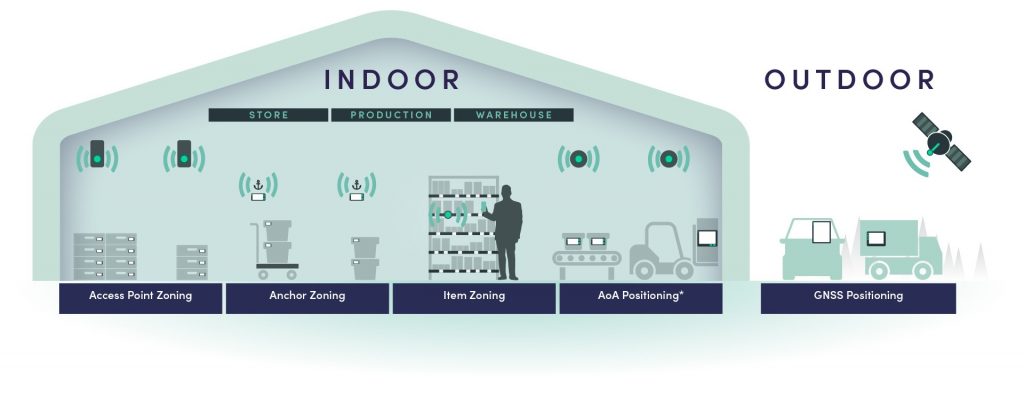
Location-based information refers to the contextual delivery of digital content based on the physical position of an object. Within the sepioo® ecosystem, multiple technologies support indoor and outdoor positioning — enabling automated actions, API triggers, and content updates across logistics and production workflows.
The sepioo® Cloud acts as the central intelligence layer: it processes object positions, manages zone definitions, and orchestrates display behavior in real time or at defined intervals. The result is synchronized interaction between physical material flow and digital process logic.
Access Point Zoning — A Simple Starting Point
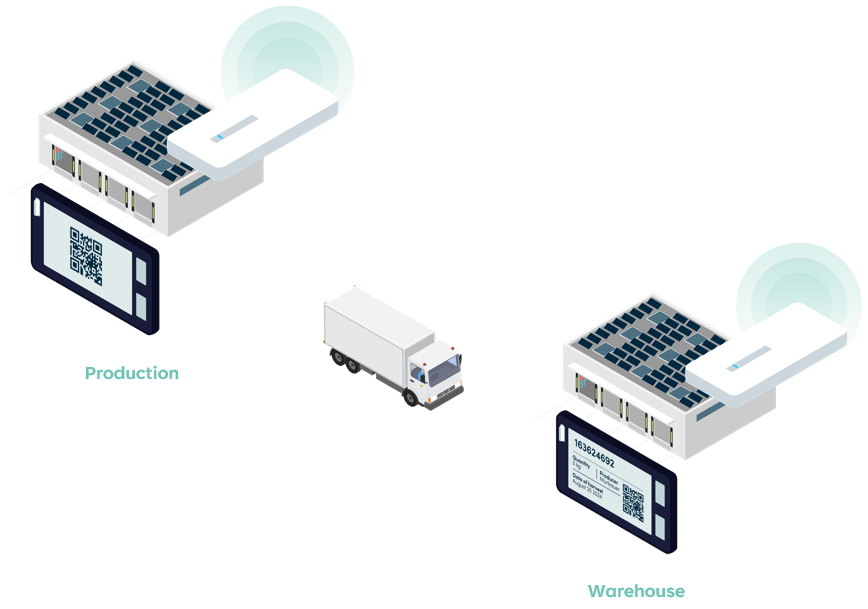
Access Point Zoning assigns a device to the nearest gateway using 2.4 GHz communication, enabling room- or building-level localization. When an asset moves between gateway areas, the sepioo® Platform can automatically trigger content updates or backend actions. This approach is ideal for coarse-grained zone logic in multi-building warehouse or production environments. To ensure seamless transitions, the platform optimizes the time factor involved in these handoffs, managing how quickly displays connect to a new gateway. These settings are fully adjustable, allowing you to fine-tune connection speeds to meet the specific requirements and timing of your individual use cases.
Access Point Zoning
Anchor Zoning: Zone-Based Intelligence for Smart Logistics
Anchor Zoning expands localization from building-level to defined operational zones. Instead of identifying only a gateway area, the system evaluates RSSI values between stationary anchors (sepioo® Button Displays) and moving objects to determine zone presence.
Using 2.4 GHz communication and BLE beaconing, sepioo® Displays function as active infrastructure components. Rather than continuous communication, positioning is triggered on-demand, providing a precise “snapshot” of the current location—making this approach ideal for inventory purposes.
Mobile objects are assigned to the nearest anchors, allowing the sepioo® Cloud to use this zoning data to push context-specific information directly to the displays. This enables users to see relevant data such as work instructions or shipping information in real-time, or allows for the seamless transfer of localization data to external backend systems.
This zone-based localization method determines whether an object is located within a defined area, making it highly effective for logistics scenarios where operational relevance is linked to zone presence.
“Anchor Zoning bridges the gap between physical material flow and digital process control — enabling zone-based automation without complex infrastructure. What makes it unique is that our sepioo® Displays are not just endpoints — they are active positioning components within the logistics architecture.”
Grid-Based and Free Anchor Zoning
Anchor Zoning can be implemented using two complementary principles.
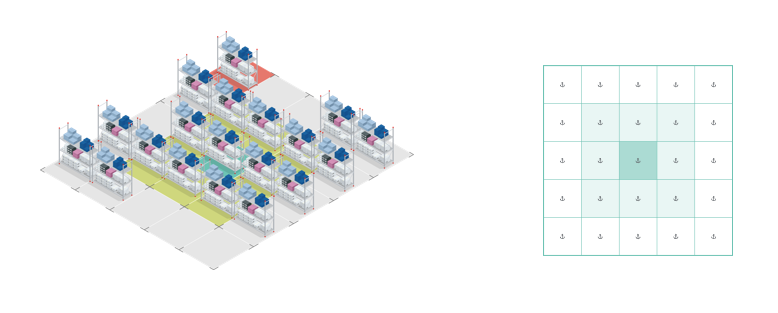
In Grid-based Anchor Zoning, anchors are positioned in the center of defined grid cells. Objects are assigned to grid zones, allowing operators to visualize location status via digital maps and detect deviations instantly.
This setup is particularly effective in structured warehouse layouts or inventory management environments.
Grid-Based Anchor Zoning
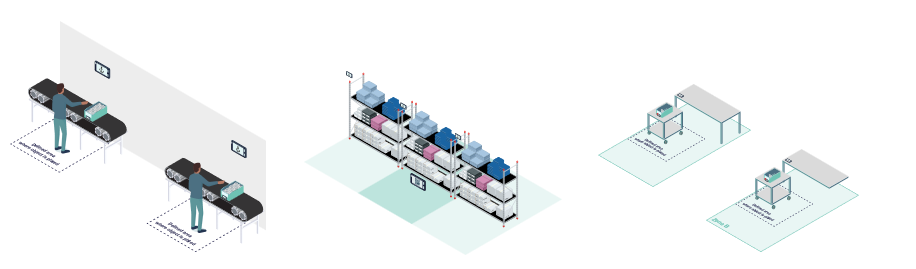
In Free Anchor Zoning, anchors can be placed flexibly at workbench level, on walls, or along shelf rows, while zones are defined according to process requirements.
This enables highly adaptable shopfloor applications, such as production line steering or dynamic material staging.
Free Anchor Zoning
The Strategic Advantage for Smart Logistics
Compared to high-precision real-time systems such as Angle-of-Arrival (AoA) positioning, Anchor Zoning provides an optimal balance between infrastructure complexity and operational value. It delivers a reliable zone-level assignment with an efficient use of hardware, energy, and data resources. Installation remains straightforward, while the sepioo® Cloud ensures centralized management of zones, triggers, maps, and actions.
For logistics organizations aiming to improve inventory visibility, reduce search times, and automate zone-based workflows, Anchor Zoning represents a pragmatic yet powerful step toward smart logistics transformation.
Experience Anchor Zoning Live at LogiMAT
With the sepioo® Platform and sepioo® Button Displays, PDi Digital turns location data into actionable logistics intelligence. Anchor Zoning transforms physical zones into digitally orchestrated process triggers — enhancing transparency, efficiency, and control.
📍 Meet our experts at LogiMAT for a personal discussion and live demo.
Let us show you how location-based intelligence can elevate your smart logistics strategy in a scalable and future-ready way.

 日本語
日本語  中文
中文